Some trims are purely functional. Lace trim isn’t one of them. Lace trim is a decorative edging that adds elegance and detail to garments and home textiles. It provides an accent to the garment’s fabric but does not become part of the garment itself. It can enhance the texture, softness, and contrast of clothing without making it feel bulky.
Designers use lace trim across women’s wear, lingerie, bridal collections, children’s apparel, and even home textiles. However, choosing the right trim goes beyond selecting a pattern.
What Is Lace Trim?

Lace trim is a small piece of lace that is used to give an edge, seam, or accent to clothing items, home textiles, and other textiles.
Lace trim serves to decorate. It adds texture, pattern, and contrast in a controlled manner. Because lace is manufactured in certain widths and has repeating patterns, designers can pinpoint the areas where intricate details are to be added with precision. Various lace trims feature delicate floral patterns, while others incorporate geometric shapes, embroidery, or beading.
In terms of manufacturing and production, lace trims offer tremendous flexibility. They can enhance the perceived value of clothing, help highlight design features, and make an ordinary product stand out with very little additional fabric. Furthermore, if the lace trim is secured properly, it can be used for both mass production and small-batch collections without any problems.
Common Uses of Lace Trim

Many different types of products use lace trim because lace can add a touch of sophistication to a product without adding extra weight.
Lace trim can subtly enhance a product or stand out as a key design element. It all depends on where and how much lace is used. Manufacturers use lace trim to define the shape of the product, blur its edges, and/or provide contrast against a solid fabric.
Here are just a few examples of where lace trim can be used:
- Women’s Apparel
- Lingerie & Sleepwear
- Bridal & Formalwear
- Children’s Clothing.
- Activewear & Stretch Garments
- Accessories
- Home Textile
In each case, lace trim creates an elegant end product.
Materials Used in Lace Trim
The appearance, texture, and performance of lace trim during the manufacturing process are all influenced by the characteristics of the material. For example, a lace trim used for a bridal veil might look stunning, but it might not be as durable for everyday wear garments.
| Material | Features | Application | Advantages |
|---|---|---|---|
| Cotton |
|
|
|
| Polyester |
|
|
|
| Nylon |
|
|
|
| Spandex / Elastane Blends |
|
|
|
| Polyester-Cotton Blends |
|
|
|
| Decorative Additions (Beads, Sequins, Metallic Threads) |
|
|
|
Each material offers different performance benefits. Finding the most suitable option depends on the intended use of the trim, the care methods for the finished garment, and the level of durability needed for mass production.
How to Choose the Right Lace Trim
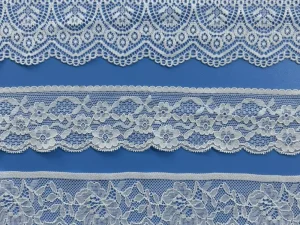
Selecting lace trimming for bulk purchase is not just about selecting something that looks good. It is also about how it will be made and how it will perform when it is put into production. Buyers who thoroughly inspect lace trim from a strategic perspective save themselves from costly delays and mismatched outcomes.
These are the key aspects that you should scan before making a bulk purchase.
Match Trim to Fabric & End Use
The very first issue to raise is always: What is going to be the application of this trim?
Elastic laces are best used for garments that fit closely, like underwear or a body-fitting dress. Rigid laces, when applied to stretch fabrics, may distort. In the same way, a lace used heavily enriched may dominate a light chiffon or rayon.
Lookout for:
- Stretch and recovery: Unquestionably needed for lingerie, sportswear, or body-hugging garments.
- Drape: Soft means easy giving and therefore, picks up more decorative elements, lighter in weight. On the other hand, if you are working with hard, firm, or stable fabrics, you may use laces that are equally hard or firm.
- Edge finish: Scalloped edges will give a defined look, while straight edges will make it easier to insert them into seams.
Selecting a trimming that suits the purpose of the garment will not only ensure smooth production but will also make it more wearable.
Width & Pattern Repeat
Width influences both style and construction. A thin lace of 1 to 2 cm will accentuate a sweet neckline or the edge of a sleeve.
Using large floral motifs for children’s wear may not be feasible, although it may look great on the bride’s wedding dress with the floral motif. Smaller motifs will give you more room to adjust the sizes of the garments.
Before confirming bulk quantities, review:
- Motif scale relative to garment size
- Placement accuracy on curved seams
- Waste percentage during cutting
These details influence fabric consumption and overall costing.
Fiber Performance
Fiber content defines the longevity of lace trims.
Cotton trims are soft and breathable, but if they are not pre-treated, they might shrink a little. Polyester and nylon types are considered to be better in terms of durability, color retention, and wrinkle resistance. The ones with a blend of spandex add stretch and recovery to the mix, which is crucial for certain clothing categories.
When sourcing wholesale, consider:
- Washing requirements of the final garment
- Resistance to pilling or snagging
- Elastic retention after repeated wear
- Long-term color stability
By carefully choosing the fiber composition, you are not only saving the quality of the product but also minimizing the chance of being faced with post-sale issues.
Color & Dye Lots
For mass production, color consistency is crucial. It is therefore necessary that color variation between dye lots be very slight, if at all, as even minor shade differences can cause the garment to look non-uniform, especially in the points of the garment, which are highly visible.
Reliable suppliers should provide:
- Clear dye lot documentation
- Lab dips or color approvals before bulk production
- Consistency across repeat orders
When lace trim must match base fabric precisely, early sampling and shade verification prevent expensive corrections later.
Source Premium Lace Trim with a Trusted Wholesale Partner
Choosing the right lace trim can greatly enhance the silhouette of your outfit. However, having a dependable supply and consistent quality are what really make the difference in the actual production. Lightspot is a wholesale lace trim supplier for cloth manufacturers, fashion brands, and textile businesses.
Besides a large range of crochet, embroidered, eyelet, elastic, and embellished lace trims, the company also offers scalable production capacity and strict quality control to make your sourcing process more straightforward and more predictable.
Whether it is for a new collection or for handling repeat bulk orders, Lightspot Trim’s crew can help you with your material selection, sampling, and large-volume needs.
Check out the whole lace trim line or get a quote today at Lightspot and be sure of taking your production to the next level.